
Turning Your Gifts Into Healing, Purpose & Global Change with Levi and Steph Ware
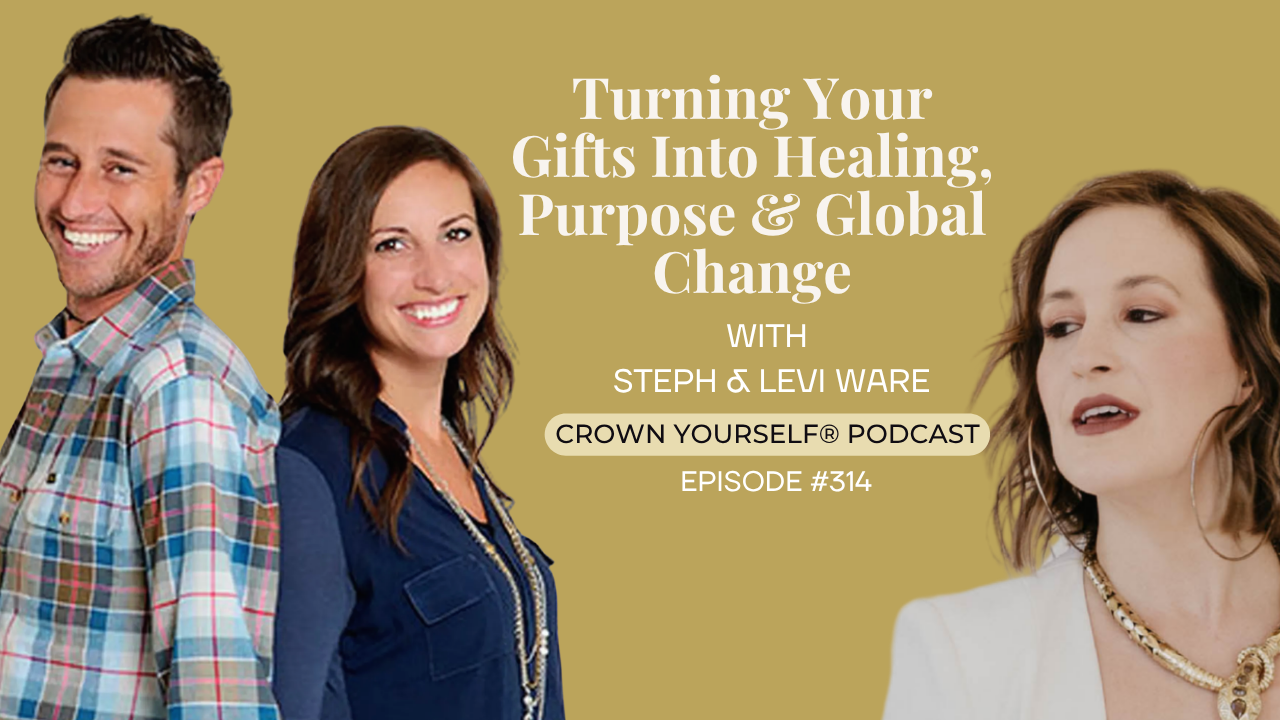
Please enjoy this transcript of the Crown Yourself Podcast, with founders of the Melodic Caring Project, Levi and Steph Ware [@melodiccaring] and, your host, transformational story coach, Kimberly Spencer (@Kimberly.Spencer)
Levi and Stephanie Ware are the founders of the Melodic Caring Project, a nonprofit that brings live, interactive music experiences to children and families facing serious illness. Combining Levi’s background as a singer-songwriter, producer, and creative visionary with Stephanie’s expertise in business operations, finance, marketing, and organizational leadership, they have built a mission-driven organization that has impacted more than 60,000 children and family members worldwide. Together, they are passionate about using creativity, compassion, and purposeful leadership to create hope, healing, and lasting impact.
Connect with Levi and Steph Ware.
Website: https://melodiccaring.org/
Facebook: https://www.facebook.com/melodiccaring
Instagram: https://www.instagram.com/melodiccaring/
Youtube: https://www.youtube.com/user/melodiccaringproject
What if the greatest legacy you leave behind has nothing to do with money, status, or success—and everything to do with the lives you touch?
In a culture obsessed with scaling faster, earning more, and building bigger brands, it's easy to forget that true leadership isn't measured by what you accumulate. It's measured by the impact you create.
In this deeply moving episode of the Crown Yourself Podcast, Kimberly Spencer sits down with Levi and Steph Ware, founders of the Melodic Caring Project, a nonprofit transforming hospital experiences for children through live music, creativity, and human connection.
What began as one livestreamed concert for an 11-year-old girl battling leukemia evolved into a global movement that has reached more than 60,000 children and families around the world. Through powerful storytelling, Levi and Steph reveal how purpose can emerge from unexpected places, why small acts of service create massive ripple effects, and how conscious leadership can transform lives.
You'll also discover their journey as founders, parents, and partners—navigating financial hardship, building a mission-driven organization, implementing EOS systems, and creating a legacy designed to outlive them.
This conversation explores sovereign leadership, servant leadership, conscious business growth, emotional resilience, purpose-driven entrepreneurship, family values, and the healing power of creativity.
If you've ever wondered how to align your gifts with your purpose, build a meaningful legacy, or create impact that transcends profit, this episode will remind you that the most powerful transformation often begins with a single act of intentional service.
*Transcripts may contain typos. We do our best to catch any human or robot errors prior to release. And we thank you in advance for your understanding. Enjoy!
Listen to the episode on Apple Podcasts, Spotify, Google Podcasts, Amazon Music, Stitcher, iHeartRadio, or your favorite podcast platform. And, you can always watch the episode on YouTube here.
Before we dive in, boundaries are everything to protecting your energy and your empire, so please note some legal boundaries before we dive into the full episode transcript:
Crown Yourself LLC and Kimberly Spencer own the copyright in and to all content in and transcripts of the Crown Yourself podcast, with all rights reserved, as well as outright publicity.
WHAT YOU’RE WELCOME TO DO: You are welcome to share the below transcript (up to 500 words but not more) in media articles (e.g., Forbes, The New York Times, CNBC The Guardian), on your personal website, in a non-commercial article or blog post (e.g., Medium), and/or on a personal social media account for non-commercial purposes, provided that you include attribution to the “Crown Yourself Podcast” and link back to crownyoutself.com/podcast URL
For the sake of clarity, media outlets with advertising models are permitted to use excerpts from the transcript per the above release.
WHAT IS NOT ALLOWED: No one is authorized to copy any portion of the podcast content or use Kimberly Spencer’s name, image or likeness for any commercial purpose or use, including without limitation inclusion in any books, e-books, book summaries or synopses, or on a commercial website or social media site (e.g., Facebook, Twitter, Instagram, etc.) that offers or promotes your or another’s products or services, except without explicit consent in writing, from Crown Yourself LLC. For the sake of clarity, media outlets are permitted to use photos of Kimberly Spencer from the Media Room at crownyourself.com/media or (obviously) licensed photos of Kimberly Spencer from Getty Images, etc.
We good? Great. Let's get to the goods.
___________
Turning Your Gifts Into Healing, Purpose & Global Change: How Levi and Steph Ware Built a Movement of Hope
Crown Yourself Podcast Episode 314
Introduction
What if your greatest impact in the world didn't come from what you built, but from how deeply you chose to serve?
In a world that often measures success by scale, revenue, recognition, and growth, it's easy to forget that some of the most powerful leaders aren't leading from center stage. They're quietly changing lives one relationship, one act of service, and one moment of connection at a time.
On this episode of the Crown Yourself Podcast, Kimberly Spencer sits down with Levi and Steph Ware, founders of the Melodic Caring Project, a nonprofit organization bringing live interactive music experiences to children facing serious illness in hospitals around the world.
What started as one concert for one child became a global movement that has impacted more than 60,000 children and family members. Their story is a masterclass in purpose-driven leadership, servant leadership, conscious business growth, and the power of turning your gifts into healing, purpose, and global change.
[00:00] What If Your Greatest Impact Came From Service?
The Leadership Question That Changes Everything
Kimberly Spencer (Host):
What if your greatest impact in the world didn't come from what you built, but from how deeply you chose to serve?
Because in a world that often measures success by scale, revenue, and recognition, there are leaders who are quietly changing lives in ways that can't be quantified, but absolutely can be felt.
If you have ever wanted your work to mean something more...
If you have felt called to use your gifts in service of others...
If you have wondered how to create impact in the hardest circumstances...
This conversation is for you.
Leadership isn't always about leading from the front.
Sometimes it's about showing up fully present in the moments that matter most.
And when you lead from that place, you don't just change outcomes.
You change lives.
Today's guests embody what it means to turn passion into purpose.
Levi and Steph Ware are the founders of the Melodic Caring Project, a nonprofit organization that brings live interactive music performances directly to children in hospitals across the country.
Through technology and heart-centered connection, they have created a way for kids facing serious illness to experience joy, creativity, and human connection right from their hospital beds.
What started as one person sharing the gift of music has grown into a movement that has reached thousands of children, families, and healthcare providers, offering not just entertainment, but moments of light during some of life's darkest seasons.
Their work is rooted in presence, compassion, creativity, and the belief that even the smallest moment of connection can change someone's day—or the rest of their life.
[03:27] How One Child's Cancer Diagnosis Sparked a Global Movement
The Origin Story of the Melodic Caring Project
Kimberly Spencer (Host):
What inspired this nonprofit, and did you ever foresee it serving at the level that it does today?
Levi Ware (Guest):
That's a great question.
I think what inspired it didn't necessarily inspire a business in our minds. It didn't even inspire a nonprofit.
It inspired a response to an immediate need.
There was a local girl in our community who was diagnosed with leukemia.
She was eleven years old.
A friend of mine who was a teacher reached out and said:
"Levi, this student is facing a really heavy diagnosis. What can we do?"
So we put together a concert to support Katie and let her know she wasn't alone.
At the time, virtual events weren't really a thing.
Everything was in person.
The goal was simple:
Surround Katie with love.
Show her that her community was standing beside her.
Steph Ware (Guest):
Ryan, the teacher, explained that everyone wanted to help.
The students wanted to help.
The staff wanted to help.
The community wanted to help.
But nobody knew what to do.
So the idea became:
Let's create a concert.
Let's create a space where people can show up and support Katie and her family.
[06:02] The Livestream That Changed Everything
When Purpose Meets Innovation
Levi Ware (Guest):
We had about 300 people gathered for the concert.
Then we found out Katie couldn't attend.
She was quarantined in the hospital preparing for a bone marrow transplant.
She was alone.
The entire purpose of the concert was to surround her with support—and now she couldn't even be there.
We happened to have a computer.
We happened to have a livestream account.
So we thought:
What if we streamed the concert directly into her hospital room?
We put the computer on the edge of the stage.
Played the show.
And then looked into the camera and said:
"Katie, everybody in this room is here for you."
"We want you to know that you're loved."
Then we turned the computer around.
Three hundred people waved at her.
Sent her love.
Sent their support.
Afterward we called Katie and her mom.
Both of them were crying.
Not because of the concert.
Because the connection worked.
The intention came through.
She knew she wasn't alone.
And that changed everything.
[08:01] Turning Passion Into Purpose
Finding a Mission Bigger Than Music
Levi Ware (Guest):
For me, music had always been my passion.
But all of a sudden we found a purpose for music that was powerful.
Something that made sense not just creatively—but emotionally and spiritually.
That was really the birth of the Melodic Caring Project.
Even though we didn't know it at the time.
Steph Ware (Guest):
For me, it was seeing how everything aligned.
Levi had always believed music could help people.
This was the first time we saw exactly how.
When we witnessed the emotional impact that concert had on Katie and her mom, we started asking:
Could we do this for more families?
Could we create this experience for more children?
And that started years of research, planning, and building.
Every Friday we'd sit down together and ask:
What does it take to make this happen?
What does it take to build something that can truly help?
[10:10] Building a Mission-Driven Nonprofit From the Ground Up
The First Steps Toward Global Impact
Steph Ware (Guest):
At the time Levi was working construction.
I was working in property management and bookkeeping.
We had young children.
No roadmap.
No blueprint.
No certainty.
We simply believed this work mattered.
We learned what it took to build a nonprofit.
We found board members.
We connected with supporters.
We built one step at a time.
And before we knew it, people were saying:
"Yes. This matters."
"Keep going."
Fifteen years later, we're still going.
And today we've impacted more than 60,000 children and family members around the world.
Levi Ware (Guest):
We call the kids "Rock Stars."
Because they truly are the rock stars.
The patients are the rock stars.
We are their number one fans.
[11:28] Music as Medicine
The Healing Power of Creativity and Human Connection
Kimberly Spencer (Host):
One of the things that stood out to me was how you've gone beyond concerts.
You've helped children process and heal through creativity.
How did that evolve?
Steph Ware (Guest):
Everything at Melodic has evolved from caring.
It's happened very organically.
The kids wanted more connection.
They wanted to talk.
They wanted to understand songwriting.
They wanted to know how songs were made.
And that naturally evolved into one-on-one music therapy sessions and songwriting experiences.
Levi Ware (Guest):
The goal was always genuine connection.
Not distraction.
Not entertainment.
Connection.
Because if children can invest their emotions into something creative, they can begin to process what they're experiencing.
They can take feelings that seem overwhelming and transform them into something meaningful.
Something they're proud of.
And that's incredibly powerful.
[16:29] The Hospital Room That Changed Everything
How Songwriting Became a Tool for Healing
Levi Ware (Guest):
There was a young boy named Nick.
He had been in the hospital for months.
He was alone.
A nurse warned me before I went into his room.
She said:
"He's angry."
"He might throw something at you."
So I walked in and told him:
"My name is Levi."
"I'm here to play you a song."
"If you like it, give me a thumbs up."
"If you don't, give me a thumbs down and I'll leave."
He was playing video games.
Didn't even look up.
I played a song.
Thumbs up.
Played another.
Thumbs up.
After the third song he put down his controller and looked at me.
He asked:
"Where do songs come from?"
I told him:
"I don't really know. They just kind of come through you."
And then he said:
"I have ideas for songs."
That moment changed everything.
He wanted to write about obstacles.
Roadblocks.
Victory.
So we started writing.
And I realized something.
These children have so many emotions bottled up inside.
They're carrying trauma.
Fear.
Uncertainty.
Pain.
But often they don't have a safe way to express it.
Songwriting gave them that outlet.
It gave them a way to process.
A way to heal.
A way to transform their story from something that happened to them into something they could own.
And be proud of.
[20:30] From Victim to Victor
Helping Children Transform Their Story Through Songwriting
Kimberly Spencer (Host):
One of the things I love about what you're doing is that you're helping these kids move from being defined by their circumstances to becoming the authors of their story.
Levi Ware (Guest):
Absolutely.
What we discovered through songwriting is that when a child can take what they're experiencing and put it into words, it changes their relationship to it.
Instead of feeling powerless, they begin to feel empowered.
Instead of carrying something that's happening to them, they're creating something from it.
There's a huge difference.
A lot of these kids are facing situations they never asked for.
They're dealing with pain.
They're dealing with fear.
They're dealing with uncertainty.
But when they create a song, all of a sudden they're creating something beautiful from those experiences.
They're transforming it.
And that's where healing starts.
Kimberly Spencer (Host):
That's alchemy.
That's literally taking an experience and turning it into something meaningful.
Levi Ware (Guest):
Exactly.
And that's what creativity does.
It allows us to take our experiences and create meaning from them.
[23:08] Raising Purpose-Driven Children
Modeling Compassion, Service, and Leadership at Home
Kimberly Spencer (Host):
You've built this incredible organization while raising children.
How have you taught your kids about service and compassion?
Steph Ware (Guest):
I think the biggest thing is modeling it.
Children are always watching.
They don't necessarily do what we say.
They do what we do.
If we're talking about kindness but not practicing it, they notice.
If we're talking about compassion but not living it, they notice.
So for us, it's always been important that our kids see the work.
That they understand why we do it.
That they witness people helping people.
Levi Ware (Guest):
Your values have to be lived and demonstrated.
Trying to impart compassion and love through words alone is almost pointless.
Children learn by example.
They learn by watching how you treat people.
How you respond to challenges.
How you show up when someone needs help.
That's where values become real.
Steph Ware (Guest):
It's our faith in action.
Whether it's your faith, your values, or your personal beliefs, they should be visible through your actions.
Not just your words.
Because actions create credibility.
Actions create trust.
And that's what children remember.
[27:00] Leadership Starts at Home
Why Family Is the First Place We Practice Service
Kimberly Spencer (Host):
I think that's such an important distinction because leadership often gets framed as something we do in business.
But leadership starts long before that.
Steph Ware (Guest):
Absolutely.
Leadership starts in the home.
It starts with how we communicate.
How we serve one another.
How we support each other.
How we handle conflict.
Those lessons become the foundation for everything else.
Levi Ware (Guest):
The goal isn't perfection.
The goal is intentionality.
Every day we have opportunities to demonstrate what matters most.
Those small moments add up.
They become culture.
They become character.
They become legacy.
[30:16] Building a Legacy That Outlives You
The Ripple Effect of Small Acts of Service
Kimberly Spencer (Host):
What does legacy mean to both of you?
Levi Ware (Guest):
For me, legacy isn't about being remembered.
It's about creating something that continues helping people long after you're gone.
If all of us live intentionally with small acts of kindness in our own sphere, we will impact the world and change it for the better.
Most people think they need to solve global problems.
But that's overwhelming.
What if instead we focused on helping the people directly in front of us?
That's where change begins.
Steph Ware (Guest):
Legacy is creating a ripple effect.
You may never know how far your impact reaches.
But every act of kindness creates another opportunity for kindness.
Every act of generosity inspires another act of generosity.
That's how transformation spreads.
Kimberly Spencer (Host):
It's easy to underestimate the impact of one moment.
One conversation.
One act of service.
One decision to care.
But those moments can change the trajectory of someone's life.
[35:50] Why Artists Have the Power to Change the World
Creativity, Purpose, and Human Connection
Kimberly Spencer (Host):
Levi, as an artist, what responsibility do you think creators have in today's world?
Levi Ware (Guest):
Artists have an incredible opportunity.
Art has always helped people process what they're experiencing.
Music.
Stories.
Paintings.
Poetry.
All of it creates connection.
All of it helps people feel seen.
And when people feel seen, healing becomes possible.
I think artists have a unique ability to remind people that they're not alone.
That's powerful.
Kimberly Spencer (Host):
Especially today.
In a world where technology continues to grow, authentic human connection becomes even more valuable.
Levi Ware (Guest):
Absolutely.
Technology is a tool.
Connection is the goal.
The technology helped us reach hospital rooms.
But it was the connection that mattered.
It was always about the people.
[37:22] Marriage, Business & Mission
Building a Purpose-Driven Organization Together
Kimberly Spencer (Host):
You have built a marriage, a family, and a mission together.
What have you learned about working with your spouse?
Steph Ware (Guest):
It's not always easy.
People see the results.
They don't always see the conversations.
The challenges.
The disagreements.
The growth that's required.
But at the end of the day, we both care deeply about the mission.
And that gives us something bigger than ourselves to focus on.
Levi Ware (Guest):
Having a shared purpose changes everything.
Because when things get difficult, you can come back to the mission.
You can remember why you're doing the work.
That creates resilience.
[40:16] Communication, Conflict & Staying on the Same Team
The Relationship Principle That Changes Everything
Kimberly Spencer (Host):
What's the biggest lesson you've learned about communication?
Steph Ware (Guest):
The starting point is recognizing that you're on the same team.
That sounds simple.
But it's powerful.
Most conflicts escalate because people start viewing each other as opponents.
Instead of teammates.
Instead of partners.
Instead of people working toward the same goal.
When you remember you're on the same team, the conversation changes.
Levi Ware (Guest):
You're no longer trying to win.
You're trying to solve the problem together.
That's a completely different mindset.
Steph Ware (Guest):
Exactly.
The question stops being:
"How do I prove I'm right?"
And becomes:
"What's best for the mission?"
"What's best for our family?"
"What's best for the outcome we're trying to create?"
[43:19] Visionary vs. Integrator
The Leadership Dynamic Behind Sustainable Growth
Kimberly Spencer (Host):
Let's talk about roles because I know many entrepreneurial couples struggle with this.
Steph Ware (Guest):
One of the biggest breakthroughs for us was understanding our strengths.
Levi is the visionary.
I'm the integrator.
Once we understood that dynamic, everything became easier.
Because we stopped trying to be each other.
Levi Ware (Guest):
The visionary sees possibilities.
The integrator creates the structure to make those possibilities real.
You need both.
Without vision, you don't grow.
Without execution, nothing happens.
Steph Ware (Guest):
Learning to trust each other's strengths was transformational.
Instead of competing, we started complementing each other.
And that's when real momentum started happening.
[46:44] Boundaries, Burnout & Building Extraordinary Lives
Protecting Your Relationship While Growing Your Mission
Kimberly Spencer (Host):
Many founders struggle with burnout.
How have you navigated that?
Steph Ware (Guest):
Boundaries.
And intentionality.
We learned the hard way that if you don't create boundaries, the work will consume everything.
Especially when you care deeply about the mission.
Levi Ware (Guest):
There's always more work to do.
Always.
But if you sacrifice your health, your relationships, or your family in the process, eventually the mission suffers too.
Steph Ware (Guest):
You have to be intentional about creating space.
Space to rest.
Space to connect.
Space to dream.
Space to evaluate where you're headed.
That's what sustains long-term impact.
Kimberly Spencer (Host):
I think that's such an important reminder.
Because extraordinary lives aren't built accidentally.
They're built intentionally.
And that intentionality applies to our businesses, our relationships, our families, and the legacy we're creating.
Key Theme of This Section
As Levi and Steph Ware demonstrate throughout their journey, Turning Your Gifts Into Healing, Purpose & Global Change isn't about reaching millions overnight. It's about consistently choosing service, modeling your values, strengthening your relationships, and creating meaningful impact one person at a time. Their story is a powerful reminder that legacy isn't built through scale alone—it's built through intentional acts of leadership, compassion, and connection.
[49:49] Strategic Planning for Life, Family & Business
Creating a Vision for the Life You're Building
Kimberly Spencer (Host):
One thing I admire about both of you is how intentional you've been—not just with your organization, but with your family and your life.
How do you stay aligned?
Steph Ware (Guest):
We schedule time to step away and look at the bigger picture.
Not just for the organization.
For our marriage.
For our family.
For our future.
Because if you're always operating inside the day-to-day, it's easy to lose sight of where you're going.
Levi Ware (Guest):
Those conversations are incredibly important.
We ask ourselves:
What's working?
What's not working?
What needs to change?
What do we want the next year to look like?
The next five years?
The next ten?
Steph Ware (Guest):
Intentional planning gives us clarity.
And clarity creates alignment.
Without that alignment, it's easy to drift.
[52:49] Stop Drifting Through Life
Why Intentionality Creates Extraordinary Results
Kimberly Spencer (Host):
One of the biggest challenges I see with entrepreneurs is that they're incredibly busy but not necessarily intentional.
Steph Ware (Guest):
Exactly.
There's a difference between activity and progress.
You can be busy all day and still not move closer to the life you want.
That's why planning matters.
That's why vision matters.
Because if you aim at nothing, you'll hit it every time.
Levi Ware (Guest):
Life doesn't happen by accident.
Neither does impact.
Neither does legacy.
Those things are created through intentional choices made consistently over time.
Kimberly Spencer (Host):
I think that's one of the most important leadership lessons there is.
Because extraordinary results don't come from extraordinary moments.
They come from extraordinary consistency.
[57:06] The First System Every Founder Needs
Reducing Chaos and Creating Clarity
Kimberly Spencer (Host):
What advice would you give to founders who feel overwhelmed?
Levi Ware (Guest):
Document what you're doing.
Most founders carry everything in their heads.
And that's exhausting.
When everything depends on one person, growth becomes incredibly difficult.
Steph Ware (Guest):
Systems create freedom.
A lot of entrepreneurs resist systems because they think systems create restrictions.
But the opposite is true.
Systems create consistency.
Consistency creates capacity.
Capacity creates growth.
Levi Ware (Guest):
The first step doesn't have to be complicated.
Start writing things down.
Create processes.
Capture knowledge.
That alone can be transformational.
[1:02:15] How EOS Transformed Their Organization
Building a Mission That Can Scale Sustainably
Kimberly Spencer (Host):
You mentioned EOS earlier. How has that impacted your organization?
Steph Ware (Guest):
EOS completely changed how we operate.
It gave us language.
It gave us structure.
It gave us accountability.
Most importantly, it helped us move from reacting to leading.
Levi Ware (Guest):
As organizations grow, complexity grows.
EOS helped us simplify.
It helped us identify priorities.
It helped us make decisions.
It helped us create alignment across the entire organization.
Steph Ware (Guest):
The systems didn't replace the mission.
They strengthened it.
Because when operations improve, you're able to serve more people more effectively.
[1:05:57] Building High-Performance Teams & Accountability
Leadership Through Transparency and Ownership
Kimberly Spencer (Host):
What role does accountability play in growth?
Steph Ware (Guest):
A huge role.
People often think accountability is about punishment.
It's not.
Accountability is about ownership.
It's about clarity.
It's about making commitments and following through.
Levi Ware (Guest):
Transparency matters too.
People perform better when they understand the mission.
When they understand expectations.
When they know how their work contributes to something meaningful.
Steph Ware (Guest):
High-performing teams are built on trust.
Trust is built through communication.
And communication creates alignment.
[1:09:46] Scaling a Mission Without Losing Your Purpose
Sustainable Growth Through Service
Kimberly Spencer (Host):
As you've grown, how have you protected the heart of the organization?
Levi Ware (Guest):
We always come back to why we started.
The mission remains the anchor.
The goal isn't growth for growth's sake.
The goal is impact.
Growth simply allows us to increase that impact.
Steph Ware (Guest):
Every decision gets filtered through the mission.
Does this help us serve people better?
Does this support our purpose?
If the answer is yes, we move forward.
If not, we don't.
Kimberly Spencer (Host):
That's such a powerful framework.
Purpose becomes the filter.
Mission becomes the compass.
And growth becomes the result.
[1:10:47] Rapid Fire Questions
Leadership, Legacy & Life Lessons
Rapid Fire Q&A
Q: What's one book that's had a significant impact on your life?
- Levi Ware: Books that challenge me to think differently and expand my perspective have always had the greatest impact.
- Steph Ware: Books focused on leadership, personal growth, and intentional living continue to influence how I lead and serve.
Q: What's a lesson you wish you learned earlier?
- Levi Ware: Focus on what truly matters and don't get distracted by things that don't align with your purpose.
- Steph Ware: Trust the process and recognize that meaningful growth takes time.
Q: What's one quality every great leader must have?
- Levi Ware: Empathy.
- Steph Ware: Integrity.
Q: What inspires you today?
- Levi Ware: The resilience and courage of the children we serve.
- Steph Ware: Seeing people step into their purpose and create positive impact.
[1:15:26] What Does It Mean to Crown Yourself?
The Crown Yourself Question
Kimberly Spencer (Host):
At the end of every episode, I ask our guests the same question.
What does it mean to you to crown yourself?
Levi Ware (Guest):
To me, crowning yourself means recognizing that leadership comes with responsibility.
It's understanding that your gifts aren't just for you.
They're meant to be shared.
They're meant to be used in service of others.
It's choosing to live intentionally.
To lead intentionally.
And to make a positive impact wherever you can.
Steph Ware (Guest):
For me, crowning yourself means becoming the best version of who you were created to be.
It means living aligned with your values.
Leading with integrity.
Serving with purpose.
And recognizing that every day is an opportunity to leave people better than you found them.
Kimberly Spencer (Host):
Beautiful.
I love that.
Because that's exactly what leadership is.
Not power.
Not status.
Not recognition.
Service.
Responsibility.
Impact.
Final Takeaways
Turning Your Gifts Into Healing, Purpose & Global Change
Throughout this conversation, Levi and Steph Ware demonstrated that extraordinary impact rarely begins with a grand strategy.
It begins with a decision.
A decision to serve.
A decision to care.
A decision to use your gifts in service of something greater than yourself.
What started as a single livestream concert for one child battling leukemia became a global movement that has touched more than 60,000 children and family members around the world.
Not because they chased scale.
Because they pursued purpose.
Their journey reminds us that:
- Purpose precedes scale.
- Service precedes influence.
- Trust precedes growth.
- Legacy is built one act of compassion at a time.
- Leadership starts at home and expands outward.
- Systems and structure allow purpose to scale sustainably.
- Small acts of kindness can create global impact.
Most importantly, they remind us that every one of us has gifts.
And when those gifts are aligned with service, healing, and human connection, they become catalysts for transformation.
About the Guests
Levi and Steph Ware
Levi and Steph Ware are the founders of the Melodic Caring Project, a nonprofit organization dedicated to bringing hope, healing, and meaningful human connection to children and families facing serious illness through the power of music. Combining Levi's background as a singer-songwriter, producer, and creative visionary with Steph's expertise in business operations, finance, marketing, and organizational leadership, they have built a mission-driven organization that has impacted more than 60,000 children and family members worldwide.
Together, they are passionate about using creativity, compassion, and purpose-driven leadership to create lasting impact and inspire others to serve.
Listen to the Full Episode
If this conversation inspired you to think differently about leadership, legacy, and service, share this episode with someone who is building a business, leading a team, raising a family, or searching for deeper purpose.
Because the world doesn't need more people chasing significance.
It needs more people willing to use their gifts in service of something greater.
And that is how we create healing, purpose, and global change.
🎙️ Listen to the full Crown Yourself Podcast episode with Levi and Steph Ware and discover what becomes possible when passion meets purpose and service becomes legacy.
The Crown Yourself Podcast is a fast-growing self-improvement podcast, ranked in the top #200 personal-development podcasts in two countries, so far, out of 4.5 million podcasts. Each week, you get the conscious leadership strategies you need to help you reign with courage, clarity, and confidence so that you too can make the income and impact you deserve. Imagine this podcast as your royal invitation to step into your full potential and reign in your divine purpose. To listen to any of the past episodes for free, check out this page.
